 Local Shutter Installers
Primer · Long note
External roller shutters on UK houses
Updated
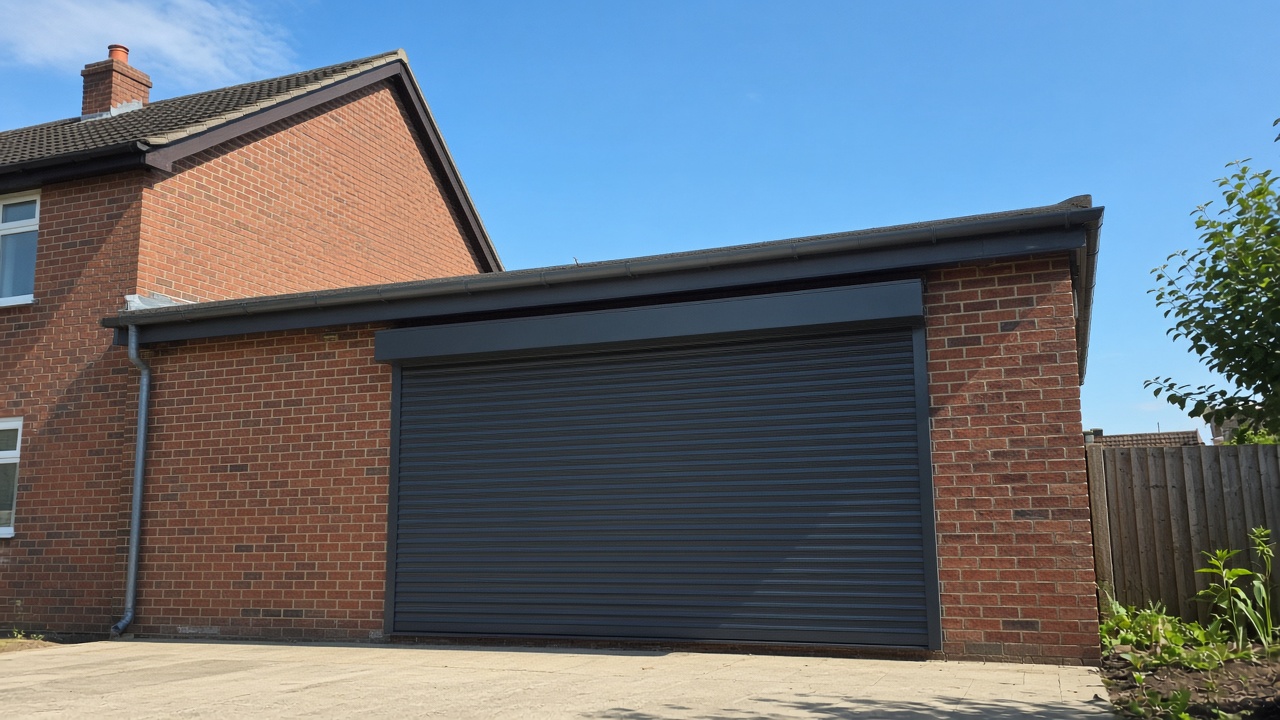
The shutters on German and French houses are external roller shutters: a metal curtain in a box above the window, outside the glass. On a British house they earn their place on rear extensions, noisy bedrooms and doors you would rather not leave as plain glass. They are a poor habit on a protected street front.
What you are looking at
Germans call them Rollladen. The French say volets roulants. The curtain is a stack of horizontal slats that roll into a box, the cassette, and run down in two side guides. When it is down it sits in the weather, not in the room. That single fact is the whole product. Internal blinds and plantation louvres live behind the pane, so the sun has already been indoors.
Most domestic curtains in this trade are double-skin aluminium with a foam fill. They are light enough to motor, stiff enough to be a nuisance to force, and they leave a still air gap against the glass. Security ranges use a heavier extruded slat. PVC slats show up in some cheap European kits and are a different, weaker thing. If a price is wildly low, ask what the slat is made of before you admire the total.
Why they turned up on British extensions
A generation of kitchen extensions was built to be a wall of glass: bifolds, sliders, and a lantern because the room had got deep. In a cool May that glass is the point of the build. In a hot July it is a radiator. The blind inside the room then tries to manage heat that has already arrived. People who grew up with a shutter on the outside of the glass are not confused by this. A lot of UK brochures still are, because 'shutters' in British retail came to mean joinery louvres.
The same houses often face a street or a side passage that is noisier than the brochure estate. A closed curtain will not silence a road, and it can take the edge off a window that was the weak point. Add the plain fact that a rear bifold is an easy way in if it is only glass, and you have the three reasons that actually produce a survey: heat, night comfort, and a slower door. Fashion is a bad fourth reason.
Three ways the box meets the wall
A front-mounted box screws to the outside face above the opening. It is the usual retrofit, and you will see it. A top-mounted box rides on a new window frame and is ordered with the window. A built-in box sits in the lintel zone and is a building job, sensible when the wall is being made and silly to fake afterwards. German streets often look calm because the box was in the wall from the start. A British terrace usually has to wear the box on the face or not have the shutter.
Guides need a flat landing, either on the frame or on the wall beside it. Shallow uPVC, bifold tracks and shaped brick reveals steal that landing. The measure is a visit with a laser, not a photograph from the patio. Boxes grow with the height of the curtain. If the soffit is shorter than the cassette, the design changes or the job stops. That is a better outcome than a box that collides with the gutter.
Summer, without the temperature fairy tale
A solid external curtain, fully down, is widely described as stopping most of the solar energy that would have passed the glass, often talked about in the region of 80 to 90 percent for an opaque shutter. ES-SO, the European solar shading organisation, exists largely to make this case: stop the sun before the pane. An internal blind cannot use the same sentence. The room temperature that follows depends on how long you left the glass bare, how hot the structure already was, and whether you can ventilate from a cooler side.
Adverts that promise the kitchen will be 5 to 8 degrees cooler are describing a glazed room on a bad afternoon, not issuing a warranty. Ask which opening, which hours, and what happens to the lantern, because a wall shutter does not shade roof glass. Perforated slats and zip screens keep a view and stop less energy. They are legitimate. They are a different brief from blackout.
Winter is the half people forget
At dusk the glass is a cold surface. A closed shutter puts a still gap in front of it and stops the room looking at the night. European guidance treats that as a real reduction in heat loss through the opening while the curtain is down, not as a new U-value for the house. It is worth having on large panes and on tired double glazing. It is not a reason to skip failed sealed units.
The habit is the product. Up in the morning if you want the low winter sun, down when the heating is doing the work. A motor earns its keep here, because a belt on four openings will be abandoned by November. A timer left on a July clock will close at the wrong hour after the clocks change. Someone has to own that tiny job.
Security, said plainly
A locked curtain over a rear bifold removes the easiest glass entry while you are out or asleep. It delays someone who came prepared. Foam-filled domestic slats and extruded security slats are different purchases. LPS 1175 results, where they exist, belong to a tested assembly of slat, guide and lock. If a quote says insurance approved, ask for the certificate that matches the assembly.
Tell the insurer what you fitted. Do not expect a discount as a right. If the shutter covers a door you would need in a fire, there must be a way to open it when the motor is dead. Solar batteries and manual overrides are design items, not surprises after the first power cut.
Solar drive, wired drive, or a belt
Somfy and Bubendorff have made solar retrofits the version people mean when they say the shutter does not need an electrician. A panel on the box charges a battery that runs a tube motor. That avoids a hole through the cavity for a cable, which is a genuine advantage on a finished brick wall. It still needs daylight on the panel. A north soffit behind a tree is how solar jobs become flat batteries in January.
A wired motor is the better machine when the sky view is poor or you are already rewiring. It is electrical work if it needs a new circuit, and it should be done as such. A belt is honest on one window you walk past and a false economy on a wall of glass you will not tour every evening with a strap.
Permission, before the factory
External shutters change the appearance of a building. Listed buildings and conservation areas are the hard cases, flats rarely have the right to clad a wall, and shopfronts are a normal planning application. Some ordinary rear installs on houses go ahead without an application, and some councils still mind. Scotland, Wales and Northern Ireland are not the English permitted-development order with a new town name.
A made-to-measure curtain is a bad thing to own if you are then told to take it down. Ask before you pay the factory. A drawing of the box, the colour and the guides, open and closed, is what a planning officer can react to. A photograph of a street in Stuttgart is not.
A rear wall, walked in order
Start at the bifold, because that is the pane people mean. Measure the clear opening, then the handles, then the headroom under the soffit. If a lantern sits above it, write 'not this shutter' next to the lantern before anyone is tempted to average the two into one price. Side lights get their own yes or no. A bedroom window on the same wall is optional and should be justified by noise or shift work, not by a wish for symmetry.
Then look at the street you cannot see from the garden. If the front is original sash in a conservation area, leave it off the order. The German postcard usually shows a house that was designed to carry the box. Yours may only have that luxury at the back, where the 2014 extension already changed the character. That is still a useful place for the product.
What the handover should include
You want the manufacturing sizes, the RAL or foil reference, the motor model, and a sentence on how the curtain opens if the drive is dead. You want the wind note if the rear is exposed. You want the fitter to run the curtain down and up twice while you watch the sill, not while they watch the van. Limits that bang are adjusted now, not after the nursery has learned to hate the noise.
Keep that pack with the house papers. A later owner, or you in six years when the handset has vanished, needs the motor family more than they need a brochure. If the drive is Somfy in someone else's curtain, both names belong on the page. One name is how warranties get shrugged off.
What this does not decide
It does not decide that every window in Britain should have a cassette. North windows you never sit beside, listed fronts, and flats without a right to the wall are outs. It does not decide between a solid curtain and a zip screen. That decision is whether you need the room dark and the door slower, or whether you need lunch with the garden still visible.
It also does not produce a payback in the way a boiler quote pretends to. You are buying a cover for particular glass: cooler when the sun is on it, less bleak after dark, and a delay if someone fancies the bifold. If none of those sentences is true in your house, do not buy the shutter because the neighbour in Munich has one.
A measured afternoon, using Newcastle as the stand-in
External roller shutters on UK houses needs a house, so this pass uses a rear wall in Newcastle. Suburban rear glass overheats on the same July days as the south, just with a shorter evening. The opening in the example is 2.4 m by 1.5 m. Nobody should order from that example. It exists so the watts and the pounds have somewhere to sit.
The survey starts at the sill, not at the brochure. Handles, tracks and the headroom under the soffit decide whether a cassette even fits. Terraces without a rear lane need a clear carry from the kerb. If the reveal is out of square, the manufacturing width is the tight one, with clearance, not the average of three careless readings.
Watts, then pounds
The worked opening for External roller shutters on UK houses is 2.4 m wide by 1.5 m high, 3.6 square metres of glass. This figure puts 645 watts per square metre on the pane and uses a g-value of 0.76, about 1765 watts into the room if the curtain is up. An opaque external shutter, taken as stopping 90 percent of that gain while it is fully down, leaves about 176 watts and keeps about 1589 watts out. That is a noon figure for comparison. An internal blind does not get the same reduction. For External roller shutters on UK houses, use the noon figure to compare two openings on the same house, then let a measured survey replace the figure.
Fitted illustration for External roller shutters on UK houses in Newcastle: £2,688 at September 2026 prices, for this 2.4 by 1.5 m opening with a solar motor. The figure allows a front-mounted aluminium curtain and ordinary fixing. It does not include scaffold, a rebuilt soffit, planning drawings, or a new window. A second opening on the same visit usually costs less than the first, because the van is already there. Compare two quotes only when the slat, the box and the drive match.
Dusk on the same pane
Winter figure for External roller shutters on UK houses: glass at 2.6 W/m2K, 3.6 square metres, a 12 degree inside-outside gap and eight night hours. The bare pane is about 0.90 kWh a night on that crude sum. A closed shutter cutting about 30 percent of the flow leaves 0.63 kWh and saves about 0.27 kWh a night, only while it is down. Open it when you want winter sun.
Short winter days make a solar motor's panel position obvious. If the panel is in shade all December, say so. For External roller shutters on UK houses, that is a reason to show the household the curtain coming down at dusk during handover, not only the summer close. A timer left on a July clock will be wrong after the clocks change. Someone has to own that five-minute job.
What would cancel the order
Stop External roller shutters on UK houses if the door is an escape route and the motor has no way to open when it is dead. A photograph is not a manufacturing size.
Do not treat a Tyneside flat as a house because it has a private entrance. The wall and the roof may still be shared. Applied to External roller shutters on UK houses, the practical bias is to shade the rear glass that overheats and to leave a protected street front alone. A made-to-measure curtain is a bad thing to own if the next letter tells you to take it off.
What to do with this note
External roller shutters on UK houses is a long note because the decision is a pile of smaller ones: which pane, which side of the glass, which box the wall can carry, whether anyone may refuse the look, and whether you will actually lower the curtain. The 2.4 by 1.5 metre example, the solar motor, and the £2,688 illustration are there so those decisions have numbers attached. They are not an order form.
Take the openings that hurt into a survey. Leave the ones that do not. Ask the fitter to repeat the brief in a sentence you recognise. If they cannot, you are being sold a range rather than a remedy. Compare the next quote against the slat, the drive and the exclusions, not against a single bold total.
Keep the summer close and the dusk close as separate habits. External roller shutters on UK houses fails if the hardware is perfect and the curtain stays in the box. It also fails if you fit it on a front the council will make you remove. The successful version is smaller than a whole-house fantasy and more specific than an advert for German streets.
Questions worth asking the fitter
Is a roller shutter the same as a plantation shutter?
No. Plantation shutters are internal louvres. A roller shutter is an external curtain in a box. They solve different problems and they are priced as different trades.
Will one shutter cool a whole extension?
It only shades the glass it covers. A bifold shutter does not shade a roof lantern. Treat each glazed surface on its own.
Can they be fitted to existing uPVC?
Often, if the frame or the reveal can take a guide and the head can take the box. Sometimes the frame is the thing that should be replaced instead. That is a survey answer.