 Local Shutter Installers
Planning · Ruling
Fitting first and applying later
Updated
Retrospective applications exist and they also fail. A refused retrospective consent can come with a requirement to remove the shutters.
What is being claimed
Manufacture is the expensive moment. The cheap moment to ask is before the factory slot.
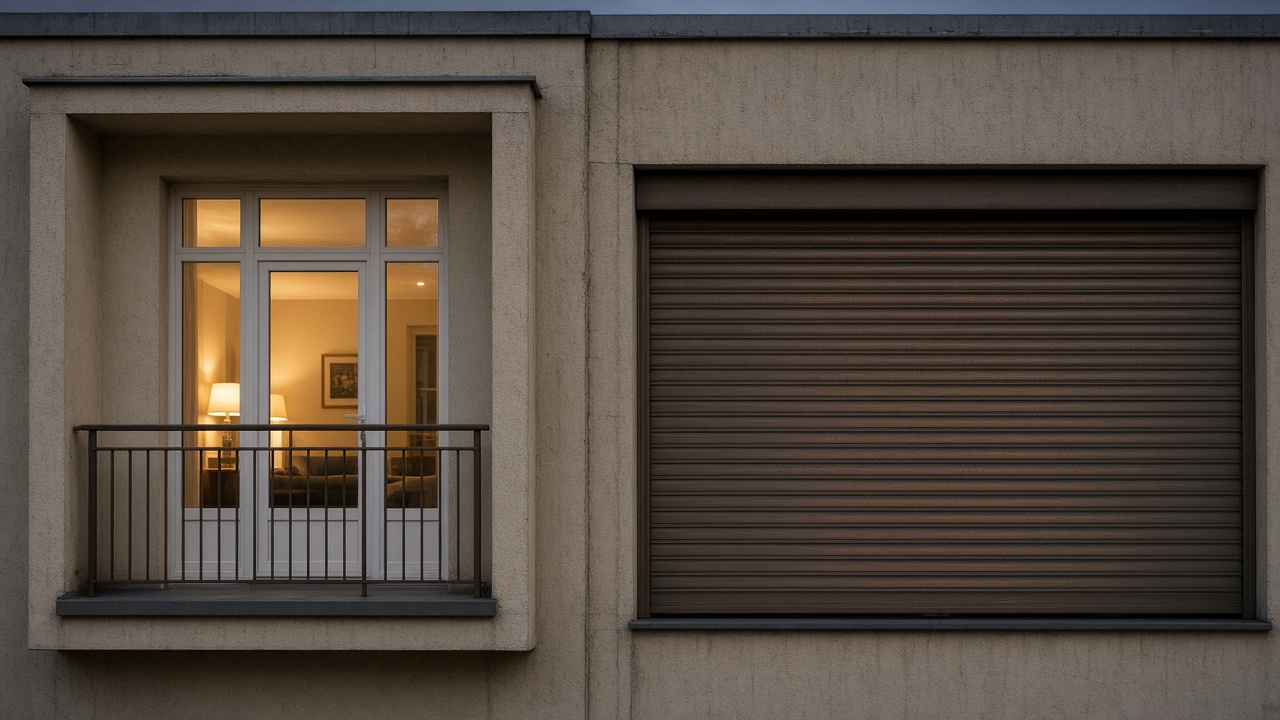
The illustration beside the claim
The worked opening for Fitting first and applying later is 2.4 m wide by 2.1 m high, 5.04 square metres of glass. This figure puts 620 watts per square metre on the pane and uses a g-value of 0.76, about 2375 watts into the room if the curtain is up. An opaque external shutter, taken as stopping 90 percent of that gain while it is fully down, leaves about 237 watts and keeps about 2138 watts out. That is a noon figure for comparison. An internal blind does not get the same reduction. For Fitting first and applying later, use the noon figure to compare two openings on the same house, then let a measured survey replace the figure.
An internal blind does not get that reduction, because the energy has already crossed the glass.
A night cover is not a consent
Winter figure for Fitting first and applying later: glass at 2.6 W/m2K, 5.04 square metres, a 12 degree inside-outside gap and eight night hours. The bare pane is about 1.26 kWh a night on that crude sum. A closed shutter cutting about 30 percent of the flow leaves 0.88 kWh and saves about 0.38 kWh a night, only while it is down. Open it when you want winter sun.
Paper before manufacture
Stop Fitting first and applying later if the frame cannot take a guide and the wall beside it is crumbling. A photograph is not a manufacturing size.
Belfast is only a setting for Fitting first and applying later. The streets there are not the product.
How to use the figure
The 2.4 by 2.1 metre opening inside Fitting first and applying later is there so a quote has something to disagree with. If the tape gives a different size, the tape wins.
The example drive is a solar motor, and the illustration is £3,406. A belt, a wired motor and a solar motor can share a curtain and still be different jobs. Compare those lines, not a single bold total.
What the survey still has to write down
For Fitting first and applying later, ask where the box lands, what colour reference will be ordered, and how the curtain opens when the motor is dead. Those three answers move the job more than a rounded price.
Leave the lantern, the side light and the next elevation off the order unless they are drawn. Fitting first and applying later covers one kind of opening. The house may have three.
When I would not order yet
Fitting first and applying later should wait if the opening is an escape door with no way to raise a dead motor, or if the front is the elevation a conservation area was drawn to protect.
A photograph is not a manufacturing size. Two quotes for Fitting first and applying later only compare when the slat, the box and the drive are the same kind of thing.
Questions worth asking the fitter
Is the price on this page a quote?
No. £3,406 illustrates Fitting first and applying later for a 2.4 by 2.1 metre opening with a solar motor, at September 2026 rates. Your survey replaces it.
Does the shutter cover every pane?
It covers the opening it is built for. Here that example is 5.04 square metres. A roof lantern, a side light or the next elevation is another line.
What if planning is unclear?
Do not pay the factory for Fitting first and applying later until a listed building, a conservation front, a flat or a shopfront has a written answer. Ordinary rear walls on houses are sometimes simpler.
What should two quotes share?
The same openings, the same slat type, and the same drive. Fitting first and applying later uses a solar motor in the example so you can see how much the motor choice moves £3,406.