 Local Shutter Installers
Plantation · Long note
Plantation shutters versus external roller shutters
Updated
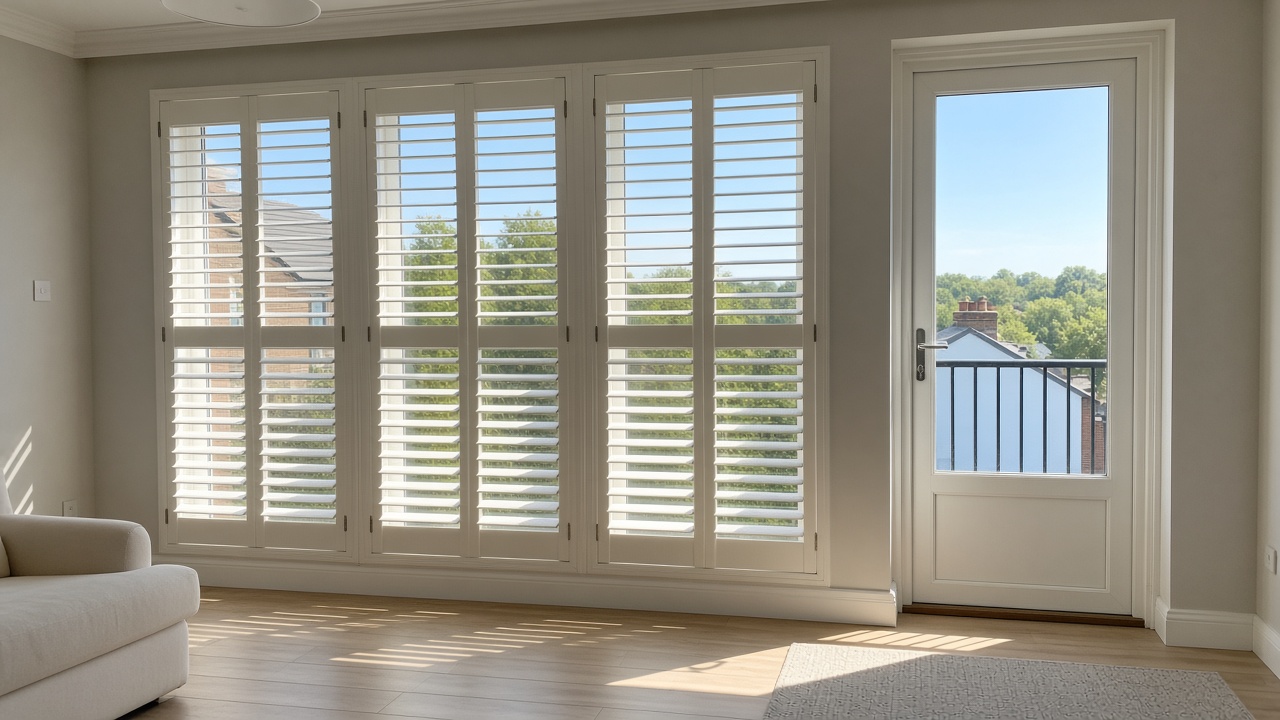
Plantation shutters are internal louvre panels. External roller shutters are a metal curtain outside the glass. UK search treats both as 'shutters'. They are different trades, different prices and different physics. Buy the one that matches the room's actual problem.
Two products sharing a word
Walk into a British shutter showroom and you will be shown hinged panels with movable louvres, fitted in the reveal, painted to match the skirtings. That trade is real, mature, and full of competent joiners. Shuttercraft, Thomas Sanderson and a crowd of local workshops live there. Walk down a street in Stuttgart and you will see cassettes and guides. That trade is also real. A website or a salesperson who quotes them as if they were finishes of the same object is muddling the brief.
Plantation panels give privacy, a tailored look, and daylight you can steer. They sit in the heated room. External rollers give solar control, a night cover and, if specified, a harder skin. They sit in the weather.
Heat, said once more because it decides the sale
If you came here because the extension is unbearable in July, plantation louvres will disappoint you. They can shade your eyes and still leave the glass to do its greenhouse work. The external curtain is the relevant estimate. If you came here because a Victorian bay looks bare and the street looks in, plantation shutters are the relevant estimate, and a roller box on that bay is often unwise and sometimes unlawful.
Some houses need both: louvres on the front bay, a roller or a screen on the rear doors. There is no prize for using one word everywhere.
Bays, arches and bifolds
Bays and arches suit panels that can be made facet by facet. Rollers want a rectangle and a straight head. Bifolds suit an external curtain or a screen, and they suit plantation shutters badly if the hope was heat control. Forcing the wrong geometry is how both products get a reputation for looking clumsy.
Tier-on-tier plantation panels are for windows you want half private. Cafe style is a modest privacy screen. Neither has an external equivalent that does the same thing, and neither belongs in a security specification.
Price and who turns up
A plantation window is often a joinery invoice in the hundreds of pounds for a simple opening, rising hard for bays and for a whole house. An external roller is a fabrication and fixing invoice that often starts near a thousand pounds for one motorised window and climbs with width. The cheaper line is not the better value if it answers the wrong problem.
The person who measures louvres may never have fixed a guide into a lintel. The person who hangs SeceuroShield may be hopeless at a bay mitre. Ask what they fitted last month.
Moisture, paint and motors
Plantation shutters in bathrooms need a material that can live with steam. External shutters need a powder coat and fixings that can live with rain. Different failures, different maintenance. Louvres get dusted and occasionally repainted. Rollers need their guides clear and their limits set.
Planning almost never cares about the louvre and sometimes cares a great deal about the cassette. On a sensitive street, that alone picks the product.
How to brief a firm without confusing them
Say 'internal louvre shutters' or 'external roller shutters' in the first sentence of the enquiry. Say which rooms, and say whether the problem is being overlooked, being too hot, being too noisy, or being too easy to open. You will get fewer beautiful quotes for the wrong object.
If a single company offers both, good. Make them write two scopes anyway. A bundled discount that drags a roller onto a listed bay is not a saving.
Showrooms and the wrong problem
A plantation showroom is good at bays, colours and the way louvres throw light on a skirt. It is a bad place to diagnose a south bifold, because every sample in the room is internal. Take the overheating sentence somewhere that will talk about the outside of the glass, even if you later return for louvres on the bedrooms.
The reverse is also true. A security shutter yard will try to solve a Victorian bay with a cassette. The bay wants panels or nothing. Knowing which door you walked through is part of reading the quote.
Bays, moisture and blackout
If the job is a bay, ask how each facet is hinged and how much clearance the reveal actually has. Cafe style and tier-on-tier are privacy shapes, not cooling systems. Bathrooms need a material that will not swell. Bedrooms that must go properly dark need you to say so, because a standard louvre leaks light around the blades.
None of that measurement skill transfers automatically to an external guide on brick. And a fitter who can set a tube-motor limit is not thereby a joiner. Split the orders if the skills split.
One sentence in the enquiry
Write 'internal plantation louvres' or 'external roller shutters' in the first line, plus the room and the problem. You will get fewer confident quotes for the other object. If a firm offers both, make them price them as separate scopes so a discount does not glue a cassette to a listed window.
Search engines mix the words. Your house does not have to. The expensive mistake is a beautiful internal shutter in a room that needed shade outside the pane, or a metal box on a window that needed a bit of privacy and nothing more.
A measured afternoon, using Bristol as the stand-in
Plantation shutters versus external roller shutters needs a house, so this pass uses a rear wall in Bristol. A south-west rear roof can cook a lantern kitchen by 3pm. The same postcode can have a north-facing terrace that does not need the same kit. The opening in the example is 1.2 m by 1.2 m. Nobody should order from that example. It exists so the watts and the pounds have somewhere to sit.
The survey starts at the sill, not at the brochure. Handles, tracks and the headroom under the soffit decide whether a cassette even fits. Steep streets and limited van parking should be priced before the deposit. If the reveal is out of square, the manufacturing width is the tight one, with clearance, not the average of three careless readings.
Watts, then pounds
The worked opening for Plantation shutters versus external roller shutters is 1.2 m wide by 1.2 m high, 1.44 square metres of glass. This figure puts 595 watts per square metre on the pane and uses a g-value of 0.7, about 600 watts into the room if the curtain is up. An opaque external shutter, taken as stopping 85 percent of that gain while it is fully down, leaves about 90 watts and keeps about 510 watts out. That is a noon figure for comparison. An internal blind does not get the same reduction. For Plantation shutters versus external roller shutters, use the noon figure to compare two openings on the same house, then let a measured survey replace the figure.
Fitted illustration for Plantation shutters versus external roller shutters in Bristol: £1,479 at September 2026 prices, for this 1.2 by 1.2 m opening with a wired motor. The figure allows a front-mounted aluminium curtain and ordinary fixing. It does not include scaffold, a rebuilt soffit, planning drawings, or a new window. A second opening on the same visit usually costs less than the first, because the van is already there. Compare two quotes only when the slat, the box and the drive match.
Dusk on the same pane
Winter figure for Plantation shutters versus external roller shutters: glass at 1.4 W/m2K, 1.44 square metres, a 12 degree inside-outside gap and eight night hours. The bare pane is about 0.19 kWh a night on that crude sum. A closed shutter cutting about 24 percent of the flow leaves 0.15 kWh and saves about 0.05 kWh a night, only while it is down. Open it when you want winter sun.
A milder winter does not retire the night-time air gap. It does make a dark box on Bath stone look harsher in photographs. For Plantation shutters versus external roller shutters, that is a reason to show the household the curtain coming down at dusk during handover, not only the summer close. A timer left on a July clock will be wrong after the clocks change. Someone has to own that five-minute job.
What would cancel the order
Stop Plantation shutters versus external roller shutters if the door is an escape route and the motor has no way to open when it is dead. A photograph is not a manufacturing size.
Conservation areas treat a visible box as a change of character. Rear plots tucked out of public view are the installs that more often proceed. Applied to Plantation shutters versus external roller shutters, the practical bias is to shade the rear glass that overheats and to leave a protected street front alone. A made-to-measure curtain is a bad thing to own if the next letter tells you to take it off.
What to do with this note
Plantation shutters versus external roller shutters is a long note because the decision is a pile of smaller ones: which pane, which side of the glass, which box the wall can carry, whether anyone may refuse the look, and whether you will actually lower the curtain. The 1.2 by 1.2 metre example, the wired motor, and the £1,479 illustration are there so those decisions have numbers attached. They are not an order form.
Take the openings that hurt into a survey. Leave the ones that do not. Ask the fitter to repeat the brief in a sentence you recognise. If they cannot, you are being sold a range rather than a remedy. Compare the next quote against the slat, the drive and the exclusions, not against a single bold total.
Keep the summer close and the dusk close as separate habits. Plantation shutters versus external roller shutters fails if the hardware is perfect and the curtain stays in the box. It also fails if you fit it on a front the council will make you remove. The successful version is smaller than a whole-house fantasy and more specific than an advert for German streets.
Questions worth asking the fitter
Which is better?
Neither in the abstract. Internal louvres for privacy and joinery. External rollers for sun, night cover and a harder opening.
Can plantation shutters black out a room?
Only if they are specified to. Standard louvres leak light. Shift-work darkness is a different request.
Do plantation shutters need planning permission?
They sit inside, so they are generally outside planning control. Listed buildings can still be a consent question.